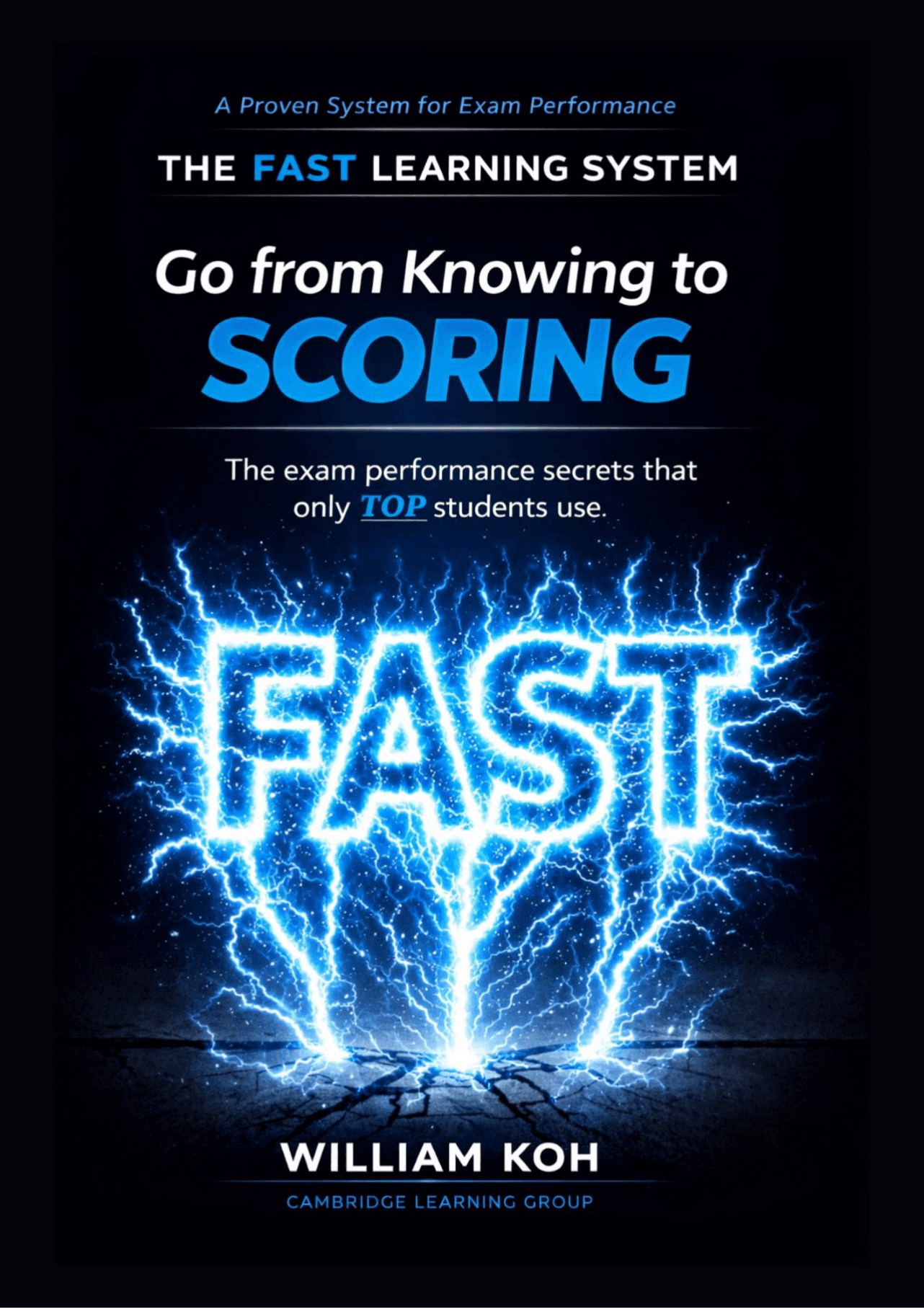
“If your child has ever stared at an exam paper, gone completely blank, and walked out feeling like they failed themselves — read this letter to the end.”
There is a four-pillar mental system that quietly separates the top scorers in every Singapore secondary classroom from the kids who “study hard but never improve.” It has been used at our centre in Jurong West to move students from F9 to A1 in a single term. It has nothing to do with intelligence. And by page 21 of this book, you will see exactly what it is.
Dear concerned Singapore parent,
It's 11:15 p.m. The kitchen light is still on.
You walk past and glance through the doorway. Your child is hunched over an assessment book, highlighter in hand. They've been at that desk since 7 p.m.
The stack of completed worksheets beside them is enormous. The neat handwriting. The colour-coded sticky tabs. The diligence that would make any teacher proud.
And you stand there, in the dark hallway, and you feel something you don't say out loud:
“He's trying so hard. Why isn't it working?”
If you've ever asked yourself that question — at the kitchen door, in the car after a parent-teacher meeting, in bed at 1 a.m. with the report book on the nightstand — what I'm about to tell you is going to come as both a relief and a shock.
The relief: your child is not lazy. Not careless. Not “just bad at Maths”.
The shock: the reason their effort isn't translating into marks has nothing to do with how hard they work — and 99% of parents (and most tutors) miss it completely.
Let me prove it to you.
The invisible gap nobody told you existed
Most parents assume knowing the subject and scoring in the exam are the same skill.
They are not.
They are not even closely related.
Knowing means your child can explain the concept at the dining table. Complete the worksheet. Nod when the teacher revises in class.
Scoring means your child can perform — under fluorescent lights, with an unfamiliar question phrased differently, a clock ticking in their peripheral vision, and 39 other students breathing around them — and convert that knowledge into marks on a script.
These are two completely different skills.
And the school system in Singapore only teaches one of them.
Every parent has seen what happens the moment that gap opens up:
- • Their mind goes blank.
- • They panic when they see a long question.
- • They misread a single keyword and lose six marks.
- • They pick the wrong method and waste twelve minutes.
- • They run out of time and leave eighteen marks unattempted.
Not a lack of knowledge. Not a lack of effort. Not a lack of intelligence.
This is the performance gap — the missing skill set that separates an A2 paper from a C5 paper, even when both students walked into the hall knowing exactly the same content.
The biggest lie
Here is the lie:
“Study harder. You'll score better.”
It sounds reasonable. It sounds responsible. Every parent has said it. Every tuition centre quietly profits from it.
And it is destroying your child.
I'll tell you a story.
A boy named Lucas came home with a C5 in his Maths mid-year. His parents reacted exactly the way most reasonable parents would — they doubled his study time. Two hours every night. No phone until homework was done. New assessment books on the desk by Sunday.
Three months of obedient, disciplined, exhausting effort.
His next paper came back: C5.
His mother sat across from me and asked the question I have heard a hundred times: “We did everything right. How is this possible?”
Here is what I told her.
They had increased the quantity of studying without changing the quality of it. More effort does not fix a poor system. It is like trying to fill a leaking bucket by pouring water in faster.
The water keeps coming out. You just exhaust yourself faster.
Lucas didn't need more hours. He needed a different system. When we shifted him to the FAST framework — the one I'm about to describe to you — his next test moved within four weeks. Not because he worked harder. Because he finally worked in a way that worked.
The parent who had already tried everything
If you've already tried tutors and the marks haven't moved, you need to read this part especially carefully.
A mother named Mrs Lim brought her daughter Sophie to me after two full years of tuition. Three different tutors. Sophie was a Secondary 3 student who studied diligently — but whose marks refused to move.
The first tutor focused on worksheets. Sophie's marks didn't move.
The second tutor focused on past-year papers. Sophie completed thirty of them. Her marks improved slightly, then plateaued.
The third tutor finally identified what was actually happening:
Sophie was consistently misreading the questions.
Not solving them wrongly. Not lacking the knowledge. Misreading them. Every single time. The exam was using one phrasing. Her practice papers had been using a different phrasing. Nobody had ever drilled her on decoding what an examiner was actually asking.
Within six weeks of fixing that one specific blind spot, Sophie's marks jumped two full grades.
The worksheets weren't wrong. The exam papers weren't wrong.
But nobody had ever diagnosed where Sophie was actually losing marks — until somebody looked closely enough.
This is the part of the story most parents don't want to hear: the problem is rarely what you think it is.
Which one of these is your child?
Across thousands of students at Cambridge Learning Group, five distinct profiles keep showing up. Each one struggles for a completely different reason. Each one needs a completely different fix.
Read these slowly. You will recognise your child in one of them — sometimes in two.
If even one of those described your child — keep reading. The next part is for you specifically.
The day a defeated student handed me his D7 paper
Three years ago, a Secondary 3 boy named Kai sat across from me with his exam script in his hand. D7. He had spent the entire previous weekend revising. He looked exhausted, embarrassed, and very close to giving up.
I asked him one question:
“When you see a question for the first time — what happens inside your head?”
He said: “I just… read it. And then I try to figure out what to do.”
I told him: “That's the problem. You're reading. You're not decoding. There's a very big difference between the two.”
I took a piece of paper and drew him a simple diagram. Five boxes. Connected by arrows. Top to bottom.
“This,” I told him, “is the Exam Reaction Cycle. It's what happens inside every student's brain — top scorers and struggling students alike — the moment their eyes land on Question 1. Same five stages. Every single time.”
The difference between Kai and the top scorer sitting two desks away wasn't the cycle itself. It was what happened at each stage.
I'm going to stop the diagram here.
Why? Because if I hand you Stages 3, 4, and 5 in this letter — out of context, in a few rushed paragraphs — you will have the headlines without the depth. Your child will not be able to actually apply any of it. The framework only works when you read each stage in order, with the case studies, with the specific drills, with the diagnostic checks that go alongside.
So I have to stop where the book begins.
What I can tell you is what happened to Kai once he got the rest of the cycle.
His next paper came back B3. From D7 to B3. In four weeks.
His mother called me the evening the results arrived. She was crying. Not from sadness. She said:
“I didn't know it could change this fast.”
The cycle is not talent. It is not luck. It is a trainable reaction pattern that any student can learn — once somebody finally lays out the full diagram and walks them through every stage.
That's exactly what Chapter 6 does. Get your copy now — the paperback ships within 1–2 working days and your child will hold the unlocked Reaction Cycle in their hands by the end of this week.
FAST: a four-pillar mental operating system for Singapore exams
Across thousands of students — regardless of school, background, or subject — the same four root causes appear again and again:
FAST is not a tuition tool. It is not more worksheets. It is not more practice papers. It is a mental operating system. It rewires how your child approaches every question — from the first second to the last.
And once that rewiring happens, FAST students consistently improve faster than students who do twice as many papers.
It is not how much you practise. It is what you practise.
What you'll discover inside this 90+ page book
- ▸The exact six-word mental script top scorers run automatically — and why most tutors have never even heard of it. (Page 21)
- ▸The five-stage Exam Reaction Cycle diagram that shows exactly where your child loses marks — usually before they've written a single number. (Page 31)
- ▸The single word on a Secondary 4 paper that cost Hui Ling 17 marks — and why no practice book had ever drilled her on it. (Page 16)
- ▸Why some students get worse in the first month of FAST — and the warning signs that this is actually a sign it's working. (Page 27)
- ▸The five student profiles — and the diagnostic checklist that tells you which one your child is in under three minutes. (Page 9)
- ▸The four invisible exam-hall hurdles every Singapore student hits — each one with a specific name and a specific fix. (Page 15)
- ▸Why “study harder” is the most damaging advice you can give your child — and the one-line replacement that took Lucas from C5 to B3 in a month. (Page 15)
- ▸How a student called Stephanie hid six marked papers face-down at the bottom of her bag — and the diagnostic process that found the same identical error in all of them. (Page 28)
- ▸The one Time-Management rule that ended Siti's habit of leaving 18 marks unattempted at the back of every paper. (Page 18)
- ▸Why a student who studies FAST for 10 minutes a day outperforms one who crams 2 hours a week. (Page 26)
- ▸The exact step-by-step study workflow your child can begin this week — laid out in Chapter 10 as a daily plan, not vague advice.
- ▸The Self-Assessment quiz on page 14: if your child answers YES to 5 of 8 questions, FAST is no longer optional.
Who this book is — and isn't — for
This book is for you if:
- • Your child puts in real effort — and the marks aren't moving.
- • Your child cries before exams, or freezes during them.
- • Your child says “I don't know how to do” when they actually do know.
- • You've already tried two or more tutors and you're tired of being told “just keep practising.”
- • You feel like you're running out of time — Prelims, O-Levels, PSLE — and you need something different. Now.
This book is not for you if:
- • You're looking for another stack of worksheets.
- • You believe the answer is just “more hours.”
- • You want a shortcut that bypasses any work from your child. (FAST works. But it works only if your child shows up. Read Chapter 5 — “The Catch” — before buying.)
The promise — and the guarantee
Here is what I'm prepared to put my name to.
If your child reads this book — really reads it — and applies the daily workflow in Chapter 10 for at least three weeks, you will see specific, measurable changes in how they approach exam questions. Cleaner workings. Faster decoding. Less panic.
I am not promising a grade jump in three weeks. Anyone who promises that is lying to you. I'm promising that the underlying skill will start to change — and from there, grades follow.
If your physical book arrives and you decide it's not for you, return it within 7 days in unmarked condition and I will refund the full S$27 — no awkward emails, no “please complete this form first.” Just write to book@topstudentsecrets.com with your order number and it's done.
That's how confident I am in this material.
How to get your copy today
The paperback is normally priced at S$77. Today, on this page, I'm releasing it for S$27 — a S$50 discount.
Why? Because most parents who would benefit most from this book will never even hear of it at the full retail price. I'd rather get it into the hands of a thousand parents at S$27 than fifty at S$77.
Here's what happens when you order:
- 1. You enter your name and email below — that's just so I can send you a confirmation email with your checkout link, in case you need to come back later.
- 2. You complete checkout with card. Stripe handles payment securely.
- 3. Your paperback ships within 1–2 working days anywhere in Singapore.
- 4. Optional: on the next page after checkout, you'll be offered a 1-click upgrade to the full ebook at S$9.90 — so your child can begin reading tonight while the paperback is in transit. (Not required. The book stands on its own.)
If your child has Prelims, O-Levels, or PSLE coming — every week without this system is a week of effort being misdirected. The system exists. The results are possible. It begins on the next page.
Looking forward to hearing your child's story,
William Koh
Founder, Cambridge Learning Group
Author, The FAST Learning System
P.S. — Re-read the Lucas story above. His parents did everything “right.” More hours. Stricter rules. No phone. Three months of obedient effort. And his marks did not move. If you've been doing the same thing — stricter routines, more tuition, longer revision sessions — and you're starting to suspect the problem is something else entirely… you are correct. The problem is the system, not the effort. Your child has the effort. They have the intelligence. They are missing one specific framework. This book is that framework. Order it now and they can start applying it this week.
P.P.S. — For S$27 — less than half the price of a single hour of private tuition — your child gets the entire framework that has moved students from F9 to A1 at our centre. If even a fraction of what's in this book lands, it changes how your child walks into every exam they sit for the rest of secondary school. If it doesn't land, return it within 7 days for a full refund. The risk is on me. Get my copy now →